
Introduction
In today’s fast-paced digital world, smartphones have become almost synonymous with personal technology. For over a decade, these devices have dominated our lives, transforming how we communicate, work, shop, and entertain ourselves. Yet, for tech giants like Apple, Google, Samsung, and emerging innovators, smartphones may soon be just a stepping stone in a much larger vision. The race is on to redefine the next generation of technology, one that moves beyond touchscreens and apps to immersive, interconnected experiences that could reshape our daily lives. From augmented reality (AR) glasses to brain-computer interfaces and wearable devices, the future promises a convergence of innovation that pushes the limits of imagination. In this article, we explore how major tech players are envisioning a world where smartphones are no longer the center of our digital universe.
1. The Limits of the Smartphone Era
While smartphones have been revolutionary, their potential is beginning to plateau. Screen sizes, battery life, and processing power continue to improve, but the form factor remains largely unchanged. Users are experiencing “app fatigue,” where the sheer number of apps and notifications becomes overwhelming. Tech giants recognize that the next wave of innovation must address not just performance, but also human experience. They are rethinking how we interact with technology—moving away from tapping, swiping, and scrolling to more natural forms of engagement. Voice commands, gestures, and even neural interfaces are emerging as potential replacements for traditional smartphone interaction. The smartphone, as we know it, may eventually become a hub or accessory, while the primary interface becomes more seamless and integrated into our daily lives.
2. Augmented Reality: The Next Visual Frontier
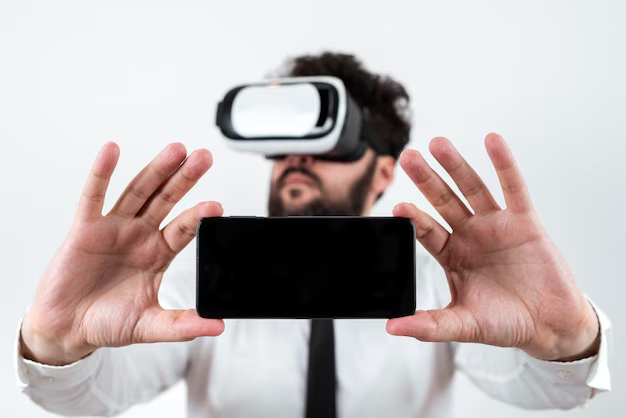
One of the most promising areas for post-smartphone technology is augmented reality. AR allows digital information to overlay seamlessly onto the physical world, providing a more immersive and intuitive experience. Companies like Apple and Google are heavily investing in AR glasses, aiming to create devices that replace the need for a phone screen entirely. Imagine walking down the street and having directions, notifications, or live translations appear directly in your line of sight, without the distraction of a handheld device. AR is not just about convenience; it could revolutionize industries ranging from education to healthcare. For instance, medical professionals could access patient data or real-time imaging while performing procedures, all without diverting attention to a smartphone. The future, as envisioned by these tech giants, sees AR not as a novelty, but as an essential interface for everyday life.
3. Wearable Technology Beyond Fitness Trackers
Wearable technology has already made its mark with smartwatches and fitness trackers, but the next generation promises to go far beyond monitoring steps or heart rate. Tech companies are exploring clothing, glasses, and even skin patches that integrate sensors and computing power. These wearables could provide continuous health monitoring, real-time environmental awareness, and even enhanced cognitive functions. Unlike smartphones, which require active engagement, these devices operate passively, gathering data and assisting users without interrupting their workflow. Samsung and Huawei, for example, are developing wearables that could monitor blood glucose or detect stress levels in real-time, providing actionable insights directly to the user. As wearables become smarter, they may replace the smartphone as the primary interface for accessing digital information, creating a world where technology supports us unobtrusively.
4. Artificial Intelligence as the Invisible Assistant
AI has already transformed how smartphones function, from predictive text to virtual assistants. In the post-smartphone era, AI will become an even more pervasive and invisible force. Instead of opening apps to find information, AI could anticipate our needs, offering solutions before we even realize we require them. Tech giants envision AI systems that integrate across multiple devices and environments, learning from our habits, preferences, and context to provide seamless support. For example, your AI assistant could automatically manage your calendar, adjust your home environment for optimal comfort, or even guide you through complex tasks using AR overlays. The role of AI will shift from reactive tools to proactive companions, creating a more intuitive and personalized technological experience that renders traditional smartphones less essential.
5. Brain-Computer Interfaces: A Glimpse into Sci-Fi Reality
Perhaps the most futuristic and ambitious concept in the post-smartphone vision is brain-computer interfaces (BCIs). Companies like Neuralink and other research-driven tech firms are exploring ways to connect the human brain directly with computing devices. BCIs could allow users to control digital interfaces, communicate, and access information using thoughts alone. While this may sound like science fiction, early prototypes have demonstrated basic functionality, such as moving cursors or controlling robotic limbs via neural signals. If scaled and perfected, BCIs could completely eliminate the need for screens, touch, or voice commands, placing technology literally inside the mind. Such breakthroughs, while still years away, demonstrate how tech giants are preparing for a future where smartphones are just one step in a broader journey toward fully integrated human-computer interaction.
6. Challenges on the Path to a Post-Smartphone World
Despite the excitement around these technologies, transitioning beyond smartphones presents significant challenges. Privacy and security are major concerns; as devices become more integrated with our bodies and environments, the potential for data misuse increases dramatically. Additionally, adoption rates may vary, as users may be hesitant to trust new forms of interaction or invest in expensive new devices. Compatibility and standardization across different companies’ technologies will also be critical to avoid fragmentation. Moreover, regulatory frameworks must evolve to address ethical concerns surrounding AI, AR, and BCIs. While tech giants are pushing the envelope, widespread societal acceptance and infrastructure readiness will determine how quickly the post-smartphone era becomes a reality.
7. How Everyday Life Could Change
If the vision of a post-smartphone world becomes reality, daily life could be transformed in ways we can barely imagine today. Communication may shift from typing messages to projecting thoughts or AR visualizations directly to others. Entertainment could become fully immersive, with holographic concerts or interactive learning environments replacing traditional screens. Health management could become continuous and preventative, with AI anticipating and addressing issues before symptoms appear. The way we navigate cities, work remotely, and even shop could be redefined by devices that are always present, always aware, and seamlessly integrated into the environment. While the smartphone will not disappear overnight, its central role may gradually diminish as these futuristic technologies take hold.
Conclusion
The smartphone has been a revolutionary tool, but tech giants are clearly looking beyond it. With innovations in augmented reality, wearable tech, artificial intelligence, and brain-computer interfaces, the next decade could see a fundamental shift in how we interact with technology. These advances promise greater convenience, deeper immersion, and more intuitive experiences, moving us toward a world where technology operates invisibly in the background, empowering us without dominating our attention. While challenges remain in privacy, adoption, and regulation, the vision is clear: the future belongs to technologies that blend seamlessly with our lives, surpassing the limitations of the smartphone era.
FAQ
Q1: Will smartphones completely disappear in the future?
Not immediately. Smartphones will likely remain important for years, but their role may evolve. They could become one of many connected devices rather than the central hub of our digital lives.
Q2: Which companies are leading the push beyond smartphones?
Apple, Google, Samsung, Meta, and startups like Neuralink are heavily investing in AR, AI, wearables, and brain-computer interfaces, exploring new ways for humans to interact with technology.
Q3: How will augmented reality change daily life?
AR can overlay digital information onto the real world, helping with navigation, learning, entertainment, and productivity without the need for a traditional phone screen.
Q4: Are brain-computer interfaces safe?
BCIs are still experimental, and safety is a key concern. Ethical use, privacy, and regulatory oversight will be critical as these technologies develop.
Q5: What’s the main challenge in moving beyond smartphones?
Privacy, security, user adoption, and technology standardization are major hurdles. Tech must be secure, reliable, and widely accepted to replace smartphones.